Trump said "there is "practically nothing left to target." This may be one of the few things the fabulist has said about the war that is true. It is an uniformed deadly perspective.
I made a comment abou this to a HuffPost article and it led to lots of replies. Here they are.

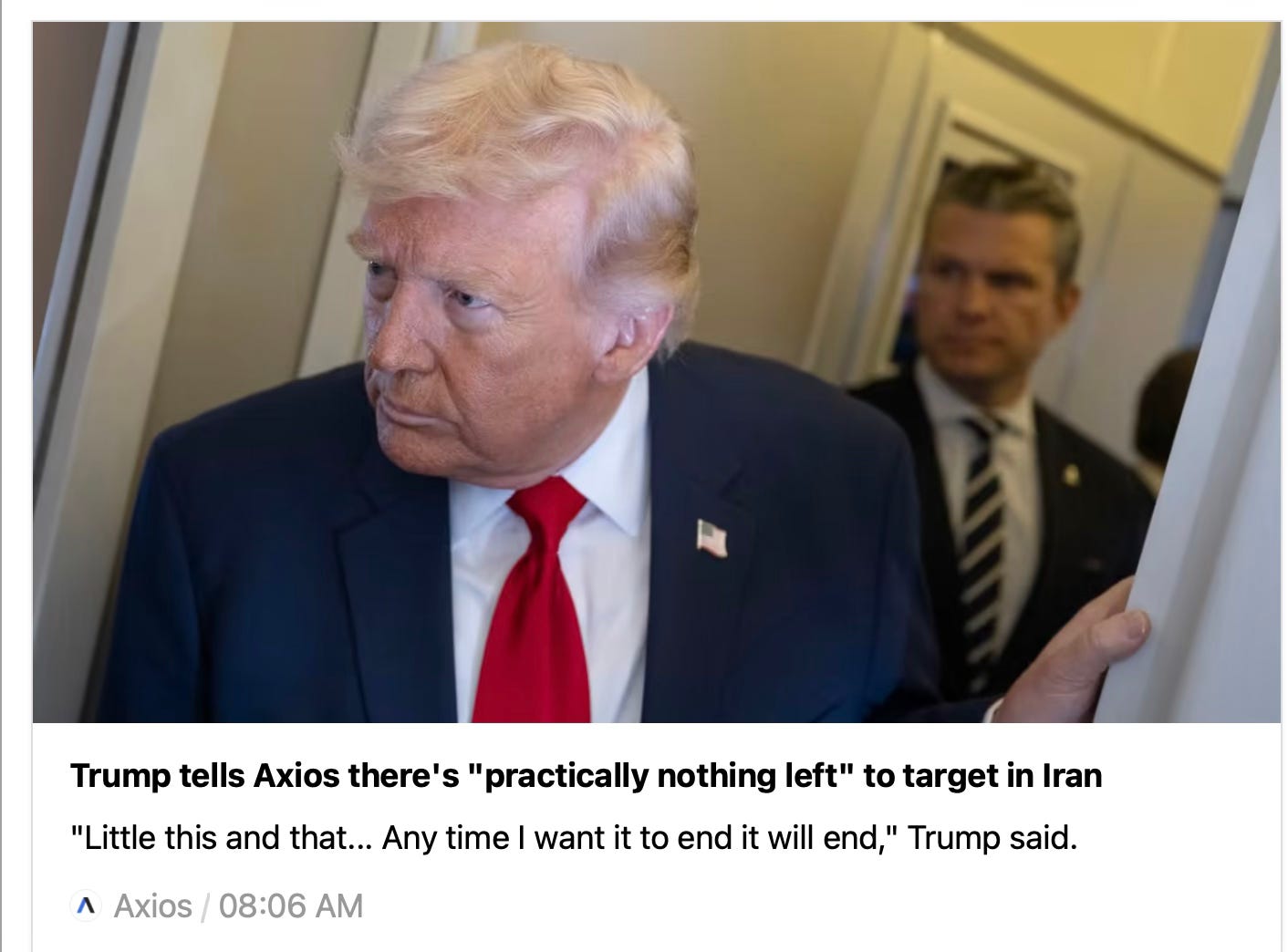
A comment which I made to the HuffPost article ‘Nothing Left To Target’: Trump Says Iran War Will ‘Soon’ Be Over” led to numerous replies, including my responses to them. I thought the comment thread was worth sharing without my adding any addtional to it.
This is what the article said:
In a brief phone interview with Axios on Wednesday morning, President Donald Trump said the U.S.-Israeli war against Iran will end “soon,” claiming that there is “practically nothing left to target.”
“Any time I want it to end, it will end,” Trump added.
Axios noted that U.S. and Israeli officials expect the fighting to continue for at least two more weeks.
The president also claimed “the war is going great,” even though seven U.S. troops have died and about 140 have been injured, according to the Pentagon.
“We are way ahead of the timetable. We have done more damage than we thought possible, even in the original six-week period,” Trump told Axios.
I wrote:
Trump says "that there is "practically nothing left to target." This may be one of the few things the fabulist has said about the war that is true. But it only is true if he doesn't count what must be the millions of small arms, ammmunition, and material to make explosive devises which hardliners have taken home with them. In the coming conflict Trump's enemies won't be gathered in actual bases. Their hideouts will be at home and they won't communicate with each other and plan attacks in electronic ways which can be intercepted.
The first reply was the sarcastic one made by Gary Weller and then it goes on from there with my making two additional replies.
Gary Weller
1 hour ago
You military expertise is amazing.
Burrito Jimmy
1 hour ago
Tell him all about yours, Larry.
Billy T Sherman
1 hour ago
Roy, Larry, Garry, bob once tried to play Call of Duty, but gave up because it scared him
Gary Weller
1 hour ago
Replying to Billy T Sherman
I served....you did NOT
Hubert Lasal
1 hour ago
He never served.
Sara Nolte
1 hour ago
Are you disagreeing? If so what part of his comment are you disagreeing with & why?
Two term Papaw
1 hour ago
The truthful parts!
Because it’s upsetting his cognitive dissonance!
Gary Weller
1 hour ago
I celebrated his amazing military expertise.
Me replying to Gary Weller
I wrote about where I actually learned about fighting a war in my Substack (below). Mostly I think this is common sense. https://halbrown.substack.com/p/how-many-years-of-losing-a-ground
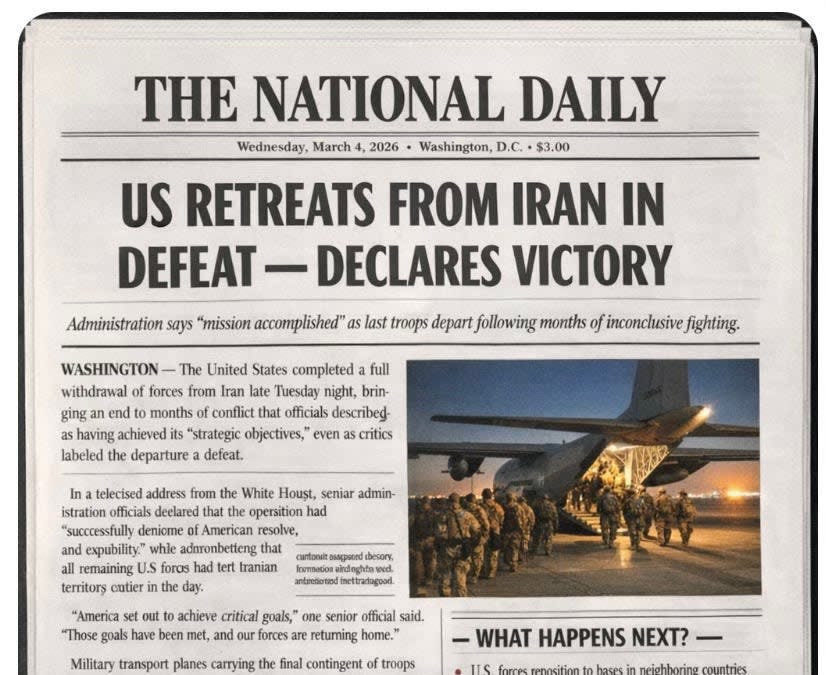
After how many years of losing a ground war in Iran will the headline re...
I am not a military expert by any means.
Gary Weller
1 hour ago
Replying to Hal Brown
so you didn’t serve
Hal Brown
1 hour ago
Replying to Gary Weller
True enough. Howver I did start the first program before the VA started their outrach programs. It was for treating Vietnam combat vets with PTSD - so I do think I made a contribution in my own way and also learned a great deal about fighting a guerilla war. (Read more about the program here > 1
Burrito Jimmy
1 hour ago
Replying to Gary Weller
Celebrated all alone, as usual.
Hubert Lasal
1 hour ago
Replying to Gary Weller
That party was boozefilled, right skippy?
Hal Brown
30 minutes ago
Replying to Hubert Lasal
Just to add to this thread appros of the notion that one has to have served in the military to have valid, and an informed and thoughtful opinion about this or any war:
Trump also did not serve. He seems to have a war movie perpsective on how to fight a war.
Having served in the military, especially in actual combat, does give one a unique perspective. This comes from having seen death up close, having killed people and had friends killed, but sometimes it comes from seeing the results of bad leadership. I learned about this second hand, but in a very powerful way, from having many combat vets as psychotherapy clients.
Scroll down to read footnote.
Thanks for reading A Beta Brain ! This post is public so feel free to share it.
…
In 1982, the Mason Mental Health Center was one of the first programs to receive a grant from the Veterans Administration to operate a program to treat Vietnam veterans suffering from delayed post traumatic stress disorder. In fact, I believe we were one of only two community mental health centers to receive such a grant. Eventually the VA itself opened outreach programs themselves all over the country, and programs like ours were phased out.
Our program began in November of 1981 without any involvement with the VA. Not a veteran myself, I had been working with a few Vietnam combat veterans in therapy. They were involved in a Vietnam veterans’ organization and were contacted by the local PBS television station, WKAR in East Lansing, MI, to put together a group to take phone calls at the station after they aired a special on post-Vietnam stress syndrome.
They suggested that I be one of the resource people available, not to take calls, but to assist those vets who were. The phone calls began to pour in after the program and I decided on the spot before too many calls came in to offer a group at Mason Mental Health for any vets who wanted to attend. A few nights later 25 showed up for the first of many vets groups, and spin-off groups for spouses of vets.
That was how we did business in those days. If we saw a need, we tried to met it. We weren’t volunteers, one of “the thousand points of light.” We were paid for what we did, but we did it because it needed to be done. The real heroes of the Vietnam veterans programs were the clients themselves. They hung together and helped each other through touch times as they dealt with inner demons.
One man in particular went on to be appointed to the Governor’s Agent Orange Commission where he distinguished himself, until he succumbed to a cancer that was probably caused by agent orange. I am certain he would give me permission to publish his name as he made no secret of having been part of the Mason Mental Health program as a client. I still have to maintain his confidentiality, but those who read this will know who he is.
I would have liked to keep the program independent from the VA, but I knew that I needed to hire a Vietnam veteran who was also a professional psychotherapist, and there weren’t many of them around. So when VA funds became available I wrote the grant and we were able to hire the first of several dedicated therapists.
Unfortunately, the VA took over much of the control of the program and while it continued almost until Mason Mental Health closed, our relationship with the VA was never very good. They insisted on approving clients before we saw them, even for first time emergency sessions that we were willing to do for free. We had to attend regular meetings at a VA center 60 miles away, and our therapists ended up having two supervisors. One, your’s truly, hated bureaucracies and the other seemed to thrive in one of the biggest bureaucracies in the government.